January 27, 2026
How CPAY built flexible crypto wallet infrastructure with Rhino.fi
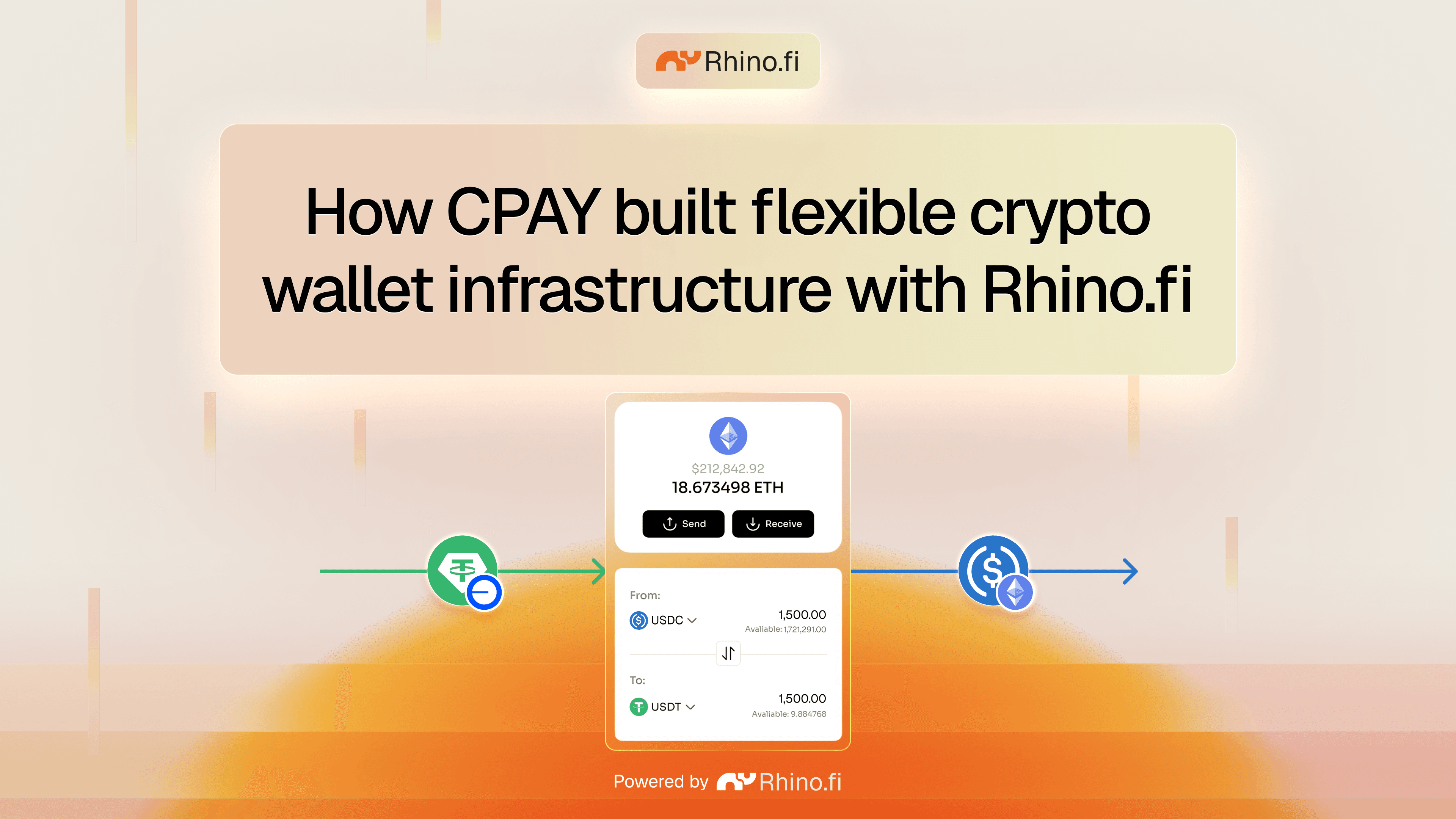
CPAY provides crypto payment and wallet infrastructure for businesses and users. As wallet products mature, expectations around asset flexibility increase. Users want to move between assets quickly and reliably, without having to think about bridges, routing, or liquidity.
To support these requirements, CPAY integrated Rhino.fi as its swap and liquidity layer.
The challenge
CPAY recently developed a custodial version of a crypto wallet and crypto payment gateway. The wallet needed to handle asset conversion directly within custodial flows, while remaining fully branded and easy to use for end users.
Behind the scenes, this introduced a set of infrastructure challenges. Swap execution had to be reliable and fast, liquidity needed to be accessible across networks, and the solution had to integrate cleanly without adding operational complexity. Managing this in-house would have required building and maintaining custom routing logic, something CPAY wanted to avoid.
Why Rhino.fi
CPAY chose Rhino.fi as the infrastructure layer to power swaps because it offered a single integration for multi-chain swap execution with unified liquidity. Rather than stitching together multiple providers or maintaining custom infrastructure, CPAY could rely on a battle-tested system already used for large-scale stablecoin flows.
This allowed the team to focus on wallet experience and product development, while Rhino.fi handled execution, routing, and liquidity abstraction in the background.
How the integration works
Rhino.fi is embedded directly into CPAY’s custodial wallet flows and operates entirely behind the scenes. When a user initiates a swap or withdrawal, Rhino.fi handles any required cross-chain conversion using unified liquidity across networks, without exposing bridge or routing complexity to the end user.
For example, if a user requests a withdrawal on the TRON network while CPAY only holds assets on BNB Chain, Rhino.fi bridges and converts the assets in the background before completing the withdrawal. From the user’s perspective, the experience remains seamless and fully branded, regardless of the underlying asset or network.
From an infrastructure perspective, CPAY gains a reusable and scalable swap layer that abstracts network constraints and can be leveraged across wallets, clients, and future use cases.
What is live and what comes next
Swap functionality powered by Rhino.fi is live across all CPAY wallet products that are currently available. The integration is fully active and provides a unified swap and conversion layer across CPAY’s ecosystem.
Going forward, CPAY will continue to build on this foundation by enhancing performance, expanding supported assets and networks, and further improving the overall user experience.
Build on Rhino.fi
By combining CPAY’s payments and wallet infrastructure with Rhino.fi’s swap and liquidity layer, CPAY can offer flexible asset conversion without increasing product complexity. The result is a more capable wallet experience for users and a modular infrastructure foundation that supports future growth.
Looking to embed swaps or liquidity into your wallet or payments flow?
Talk to the team to explore how Rhino.fi can support your use case.
CPAY provides crypto payment and wallet infrastructure for businesses and users. As wallet products mature, expectations around asset flexibility increase. Users want to move between assets quickly and reliably, without having to think about bridges, routing, or liquidity.
To support these requirements, CPAY integrated Rhino.fi as its swap and liquidity layer.
The challenge
CPAY recently developed a custodial version of a crypto wallet and crypto payment gateway. The wallet needed to handle asset conversion directly within custodial flows, while remaining fully branded and easy to use for end users.
Behind the scenes, this introduced a set of infrastructure challenges. Swap execution had to be reliable and fast, liquidity needed to be accessible across networks, and the solution had to integrate cleanly without adding operational complexity. Managing this in-house would have required building and maintaining custom routing logic, something CPAY wanted to avoid.
Why Rhino.fi
CPAY chose Rhino.fi as the infrastructure layer to power swaps because it offered a single integration for multi-chain swap execution with unified liquidity. Rather than stitching together multiple providers or maintaining custom infrastructure, CPAY could rely on a battle-tested system already used for large-scale stablecoin flows.
This allowed the team to focus on wallet experience and product development, while Rhino.fi handled execution, routing, and liquidity abstraction in the background.
How the integration works
Rhino.fi is embedded directly into CPAY’s custodial wallet flows and operates entirely behind the scenes. When a user initiates a swap or withdrawal, Rhino.fi handles any required cross-chain conversion using unified liquidity across networks, without exposing bridge or routing complexity to the end user.
For example, if a user requests a withdrawal on the TRON network while CPAY only holds assets on BNB Chain, Rhino.fi bridges and converts the assets in the background before completing the withdrawal. From the user’s perspective, the experience remains seamless and fully branded, regardless of the underlying asset or network.
From an infrastructure perspective, CPAY gains a reusable and scalable swap layer that abstracts network constraints and can be leveraged across wallets, clients, and future use cases.
What is live and what comes next
Swap functionality powered by Rhino.fi is live across all CPAY wallet products that are currently available. The integration is fully active and provides a unified swap and conversion layer across CPAY’s ecosystem.
Going forward, CPAY will continue to build on this foundation by enhancing performance, expanding supported assets and networks, and further improving the overall user experience.
Build on Rhino.fi
By combining CPAY’s payments and wallet infrastructure with Rhino.fi’s swap and liquidity layer, CPAY can offer flexible asset conversion without increasing product complexity. The result is a more capable wallet experience for users and a modular infrastructure foundation that supports future growth.
Looking to embed swaps or liquidity into your wallet or payments flow?
Talk to the team to explore how Rhino.fi can support your use case.
CPAY provides crypto payment and wallet infrastructure for businesses and users. As wallet products mature, expectations around asset flexibility increase. Users want to move between assets quickly and reliably, without having to think about bridges, routing, or liquidity.
To support these requirements, CPAY integrated Rhino.fi as its swap and liquidity layer.
The challenge
CPAY recently developed a custodial version of a crypto wallet and crypto payment gateway. The wallet needed to handle asset conversion directly within custodial flows, while remaining fully branded and easy to use for end users.
Behind the scenes, this introduced a set of infrastructure challenges. Swap execution had to be reliable and fast, liquidity needed to be accessible across networks, and the solution had to integrate cleanly without adding operational complexity. Managing this in-house would have required building and maintaining custom routing logic, something CPAY wanted to avoid.
Why Rhino.fi
CPAY chose Rhino.fi as the infrastructure layer to power swaps because it offered a single integration for multi-chain swap execution with unified liquidity. Rather than stitching together multiple providers or maintaining custom infrastructure, CPAY could rely on a battle-tested system already used for large-scale stablecoin flows.
This allowed the team to focus on wallet experience and product development, while Rhino.fi handled execution, routing, and liquidity abstraction in the background.
How the integration works
Rhino.fi is embedded directly into CPAY’s custodial wallet flows and operates entirely behind the scenes. When a user initiates a swap or withdrawal, Rhino.fi handles any required cross-chain conversion using unified liquidity across networks, without exposing bridge or routing complexity to the end user.
For example, if a user requests a withdrawal on the TRON network while CPAY only holds assets on BNB Chain, Rhino.fi bridges and converts the assets in the background before completing the withdrawal. From the user’s perspective, the experience remains seamless and fully branded, regardless of the underlying asset or network.
From an infrastructure perspective, CPAY gains a reusable and scalable swap layer that abstracts network constraints and can be leveraged across wallets, clients, and future use cases.
What is live and what comes next
Swap functionality powered by Rhino.fi is live across all CPAY wallet products that are currently available. The integration is fully active and provides a unified swap and conversion layer across CPAY’s ecosystem.
Going forward, CPAY will continue to build on this foundation by enhancing performance, expanding supported assets and networks, and further improving the overall user experience.
Build on Rhino.fi
By combining CPAY’s payments and wallet infrastructure with Rhino.fi’s swap and liquidity layer, CPAY can offer flexible asset conversion without increasing product complexity. The result is a more capable wallet experience for users and a modular infrastructure foundation that supports future growth.
Looking to embed swaps or liquidity into your wallet or payments flow?
Talk to the team to explore how Rhino.fi can support your use case.