March 6, 2026
How Karta uses Rhino.fi to turn stablecoins into spend-ready balances
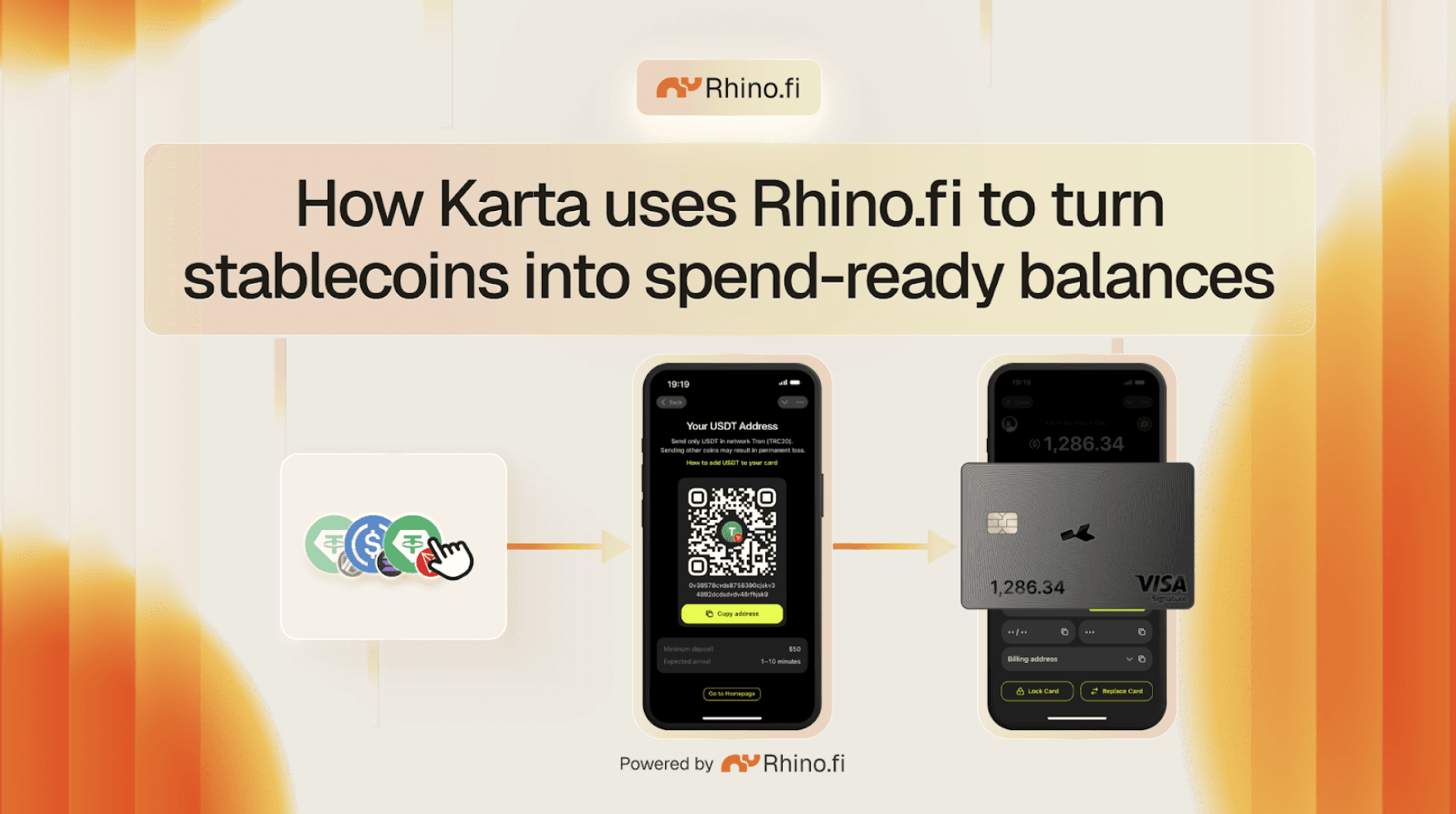
Karta turns stablecoins into spend-ready balances through virtual Visa cards. Teams hold USDT or USDC and spend globally with granular controls, real-time tracking and built-in budget management.
Karta is a self-custody crypto wallet designed for both individuals and Web3 teams who want to use stablecoins for real-world spending. Users can access virtual and physical Visa cards and personal bank details for Wire, ACH or SEPA transfers. Supporting stablecoins from multiple chains while delivering a reliable spend experience requires predictable onboarding and settlement.
Karta partners with Rhino.fi to leverage Smart Deposit Addresses, enabling stablecoin routing across multiple chains.
The product challenge
Karta users fund their wallets with stablecoins such as USDT and USDC on a range of blockchain networks including Tron, Ethereum, Polygon, Solana and others. These assets are then used to fund spend-ready balances, manage budgets, control vendor payments and track spend in real time.
From a product perspective, this introduces several challenges:
Card funding must be deterministic. Settlement uncertainty is not acceptable when funds are used for payments.
Stablecoins can originate on different chains with varying fee structures and liquidity
Funds need to arrive in Karta’s supported environment reliably before they can be used for spending
Users should not need to understand where their crypto lives or manage complex bridging flows
Karta needed a way to accept stablecoin deposits from anywhere and deliver them into spend-ready balances without exposing chain complexity to users.
Why Rhino.fi
Rhino.fi provides a chain-agnostic stablecoin onboarding toolkit that unifies deposit entry, routing, settlement and execution into a single integration.
With Rhino.fi’s Smart Deposit Addresses via SDK, Karta can:
Accept stablecoin deposits from supported chains, including Tron USDT, through a single entry point
Route and settle these deposits into the destination environment where spend balances are held
Eliminate bridge UX and chain-specific logic from the user experience
Provide predictable settlement so that funds are ready to spend as soon as they arrive
Allow users to fund from CEXs
Rhino.fi operates beneath the surface as infrastructure, abstracting multi-chain complexity and allowing Karta to focus on spend features, controls and analytics.
How the integration works
From the user’s perspective, the top-up process remains intuitive and familiar:
A user deposits stablecoins into their Karta wallet from any supported chain or CEX
Rhino.fi’s Smart Deposit Address accepts the funds and routes them to the required destination chain and environment
Funds arrive as spend-ready balances. Users can fund cards or make payments immediately
Karta’s spend controls and budgeting dashboard let users manage cards, limits and vendor payments in real time
Behind the scenes, Karta’s MPC wallet architecture manages custody while Rhino.fi ensures that stablecoin onboarding, routing and settlement occur reliably and predictably, similar to traditional payment rails.
Building card platforms, neobanks or spend tooling that needs to accept stablecoins from multiple chains?
Talk to our team about how Rhino.fi handles routing, settlement and compliance so you can focus on your core product.
Karta turns stablecoins into spend-ready balances through virtual Visa cards. Teams hold USDT or USDC and spend globally with granular controls, real-time tracking and built-in budget management.
Karta is a self-custody crypto wallet designed for both individuals and Web3 teams who want to use stablecoins for real-world spending. Users can access virtual and physical Visa cards and personal bank details for Wire, ACH or SEPA transfers. Supporting stablecoins from multiple chains while delivering a reliable spend experience requires predictable onboarding and settlement.
Karta partners with Rhino.fi to leverage Smart Deposit Addresses, enabling stablecoin routing across multiple chains.
The product challenge
Karta users fund their wallets with stablecoins such as USDT and USDC on a range of blockchain networks including Tron, Ethereum, Polygon, Solana and others. These assets are then used to fund spend-ready balances, manage budgets, control vendor payments and track spend in real time.
From a product perspective, this introduces several challenges:
Card funding must be deterministic. Settlement uncertainty is not acceptable when funds are used for payments.
Stablecoins can originate on different chains with varying fee structures and liquidity
Funds need to arrive in Karta’s supported environment reliably before they can be used for spending
Users should not need to understand where their crypto lives or manage complex bridging flows
Karta needed a way to accept stablecoin deposits from anywhere and deliver them into spend-ready balances without exposing chain complexity to users.
Why Rhino.fi
Rhino.fi provides a chain-agnostic stablecoin onboarding toolkit that unifies deposit entry, routing, settlement and execution into a single integration.
With Rhino.fi’s Smart Deposit Addresses via SDK, Karta can:
Accept stablecoin deposits from supported chains, including Tron USDT, through a single entry point
Route and settle these deposits into the destination environment where spend balances are held
Eliminate bridge UX and chain-specific logic from the user experience
Provide predictable settlement so that funds are ready to spend as soon as they arrive
Allow users to fund from CEXs
Rhino.fi operates beneath the surface as infrastructure, abstracting multi-chain complexity and allowing Karta to focus on spend features, controls and analytics.
How the integration works
From the user’s perspective, the top-up process remains intuitive and familiar:
A user deposits stablecoins into their Karta wallet from any supported chain or CEX
Rhino.fi’s Smart Deposit Address accepts the funds and routes them to the required destination chain and environment
Funds arrive as spend-ready balances. Users can fund cards or make payments immediately
Karta’s spend controls and budgeting dashboard let users manage cards, limits and vendor payments in real time
Behind the scenes, Karta’s MPC wallet architecture manages custody while Rhino.fi ensures that stablecoin onboarding, routing and settlement occur reliably and predictably, similar to traditional payment rails.
Building card platforms, neobanks or spend tooling that needs to accept stablecoins from multiple chains?
Talk to our team about how Rhino.fi handles routing, settlement and compliance so you can focus on your core product.