March 2, 2026
How Shift Protocol uses Rhino.fi to enable cross chain perpetual strategies
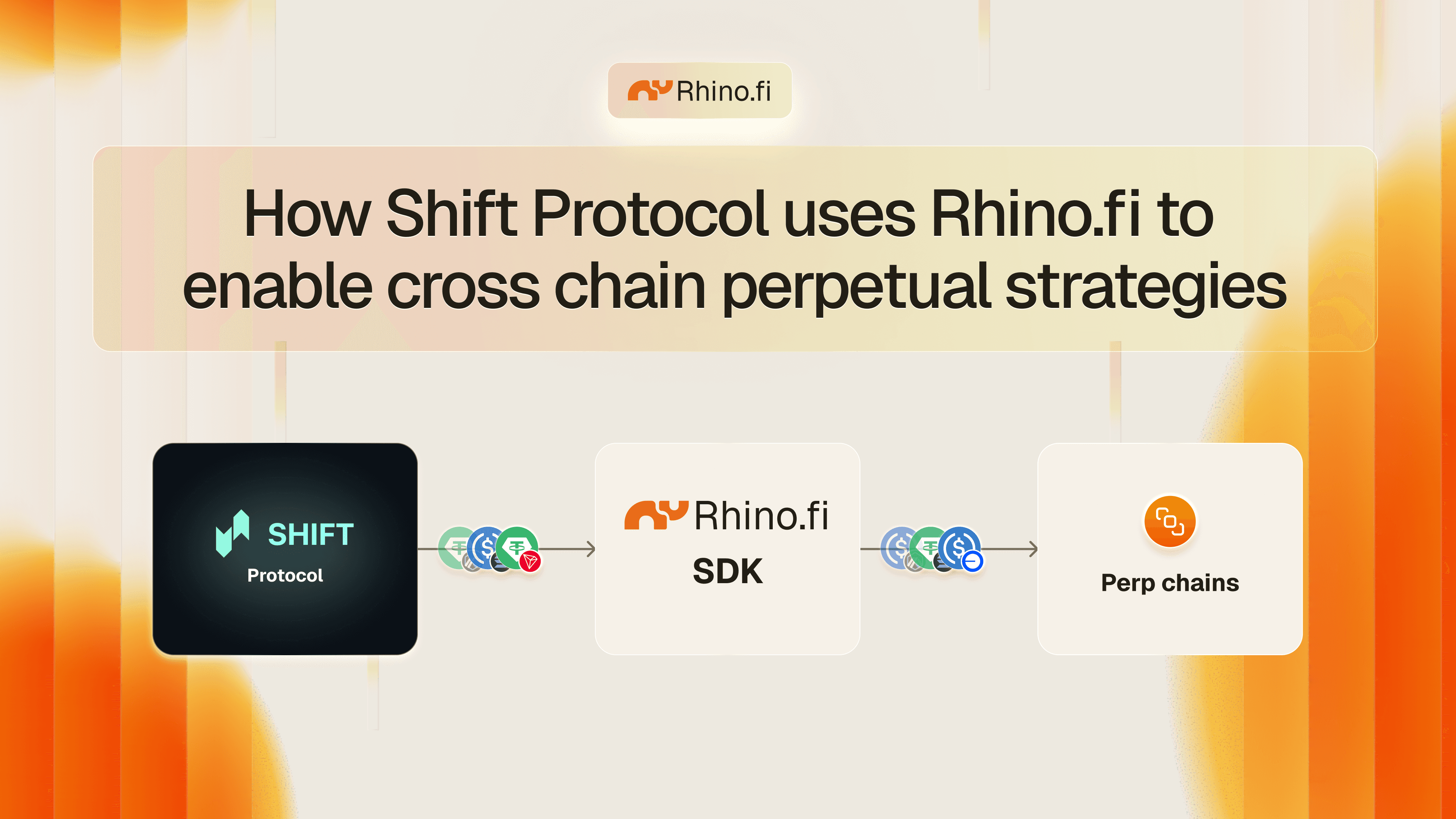
Perpetual trading strategies increasingly operate across multiple chains. Funding rates, liquidity depth, and execution conditions can differ per environment, creating opportunities for automated strategies.
The challenge is not strategy design, but capital mobility.
Shift Protocol builds automated onchain vaults that deploy stablecoin capital across perpetual trading environments. To execute these strategies efficiently, assets need to move programmatically between chains without introducing operational overhead or fragmented bridge flows.
To support this, Shift Protocol integrates the Rhino.fi SDK as its cross chain asset movement layer.
The challenge of cross chain execution for perpetual strategies
Perpetual strategies such as funding-rate arbitrage and basis trading require capital to be repositioned quickly across chains. Manual bridging or reliance on multiple tools introduces friction, delays, and execution risk.
For an automated protocol like Shift Protocol, this creates several constraints:
Capital must move programmatically, not manually
Execution must be predictable and reliable
Cross chain flows must integrate directly into strategy logic
Users should not need to manage bridge interactions themselves
Without a unified crossnchain layer, scaling strategies across multiple perp environments becomes operationally complex.
Why Shift Protocol integrated Rhino.fi
Shift Protocol uses the Rhino.fi SDK to bridge assets between perpetual trading chains as part of its automated execution flow.
By integrating Rhino.fi at the infrastructure level, Shift Protocol can:
Move stablecoin capital programmatically across perp chains
Route assets to the environments where strategies are executed
Abstract away bridge complexity from both users and internal systems
Rely on a single integration for cross chain asset movement
This allows Shift Protocol to focus on strategy design and vault logic, while Rhino.fi handles cross chain execution.
How the integration works
Rhino.fi acts as the cross chain asset movement layer within Shift Protocol’s system, providing both programmatic execution and access to stablecoin liquidity required to move capital reliably between perpetual trading environments.
When capital needs to be repositioned, Shift Protocol triggers cross chain transfers via the Rhino.fi SDK. Assets are bridged directly between supported perp chains and made available where strategies execute, without requiring users to interact with multiple bridge interfaces.
This approach enables automated cross chain execution, reduces operational overhead, and supports scalable expansion to additional perp environments over time.
Enabling scalable, automated capital deployment
By combining automated onchain vaults with programmatic cross chain infrastructure, Shift Protocol can deploy capital dynamically across perp chains as market conditions change.
For users, this means exposure to perpetual trading strategies without needing to manage cross chain operations themselves.
For Shift Protocol, it provides a scalable foundation to expand strategy coverage and chain support without rebuilding cross chain logic for each new environment.
Cross chain infrastructure as a foundation for advanced trading systems
As perpetual strategies become increasingly multichain by default, cross chain execution must be treated as core infrastructure.
Shift Protocol’s integration demonstrates how automated strategy platforms can rely on dedicated cross chain infrastructure to move capital where execution happens, reliably and at scale.
Rhino.fi provides the SDK layer that enables protocols to bridge assets programmatically between chains and support complex onchain execution flows.
If you are building perpetual trading, automated strategies, or capital deployment infrastructure that requires seamless cross chain asset movement, Rhino.fi can support programmatic execution across chains.
Perpetual trading strategies increasingly operate across multiple chains. Funding rates, liquidity depth, and execution conditions can differ per environment, creating opportunities for automated strategies.
The challenge is not strategy design, but capital mobility.
Shift Protocol builds automated onchain vaults that deploy stablecoin capital across perpetual trading environments. To execute these strategies efficiently, assets need to move programmatically between chains without introducing operational overhead or fragmented bridge flows.
To support this, Shift Protocol integrates the Rhino.fi SDK as its cross chain asset movement layer.
The challenge of cross chain execution for perpetual strategies
Perpetual strategies such as funding-rate arbitrage and basis trading require capital to be repositioned quickly across chains. Manual bridging or reliance on multiple tools introduces friction, delays, and execution risk.
For an automated protocol like Shift Protocol, this creates several constraints:
Capital must move programmatically, not manually
Execution must be predictable and reliable
Cross chain flows must integrate directly into strategy logic
Users should not need to manage bridge interactions themselves
Without a unified crossnchain layer, scaling strategies across multiple perp environments becomes operationally complex.
Why Shift Protocol integrated Rhino.fi
Shift Protocol uses the Rhino.fi SDK to bridge assets between perpetual trading chains as part of its automated execution flow.
By integrating Rhino.fi at the infrastructure level, Shift Protocol can:
Move stablecoin capital programmatically across perp chains
Route assets to the environments where strategies are executed
Abstract away bridge complexity from both users and internal systems
Rely on a single integration for cross chain asset movement
This allows Shift Protocol to focus on strategy design and vault logic, while Rhino.fi handles cross chain execution.
How the integration works
Rhino.fi acts as the cross chain asset movement layer within Shift Protocol’s system, providing both programmatic execution and access to stablecoin liquidity required to move capital reliably between perpetual trading environments.
When capital needs to be repositioned, Shift Protocol triggers cross chain transfers via the Rhino.fi SDK. Assets are bridged directly between supported perp chains and made available where strategies execute, without requiring users to interact with multiple bridge interfaces.
This approach enables automated cross chain execution, reduces operational overhead, and supports scalable expansion to additional perp environments over time.
Enabling scalable, automated capital deployment
By combining automated onchain vaults with programmatic cross chain infrastructure, Shift Protocol can deploy capital dynamically across perp chains as market conditions change.
For users, this means exposure to perpetual trading strategies without needing to manage cross chain operations themselves.
For Shift Protocol, it provides a scalable foundation to expand strategy coverage and chain support without rebuilding cross chain logic for each new environment.
Cross chain infrastructure as a foundation for advanced trading systems
As perpetual strategies become increasingly multichain by default, cross chain execution must be treated as core infrastructure.
Shift Protocol’s integration demonstrates how automated strategy platforms can rely on dedicated cross chain infrastructure to move capital where execution happens, reliably and at scale.
Rhino.fi provides the SDK layer that enables protocols to bridge assets programmatically between chains and support complex onchain execution flows.
If you are building perpetual trading, automated strategies, or capital deployment infrastructure that requires seamless cross chain asset movement, Rhino.fi can support programmatic execution across chains.