December 1, 2025
What are Post Bridge Actions and How Do They Work?
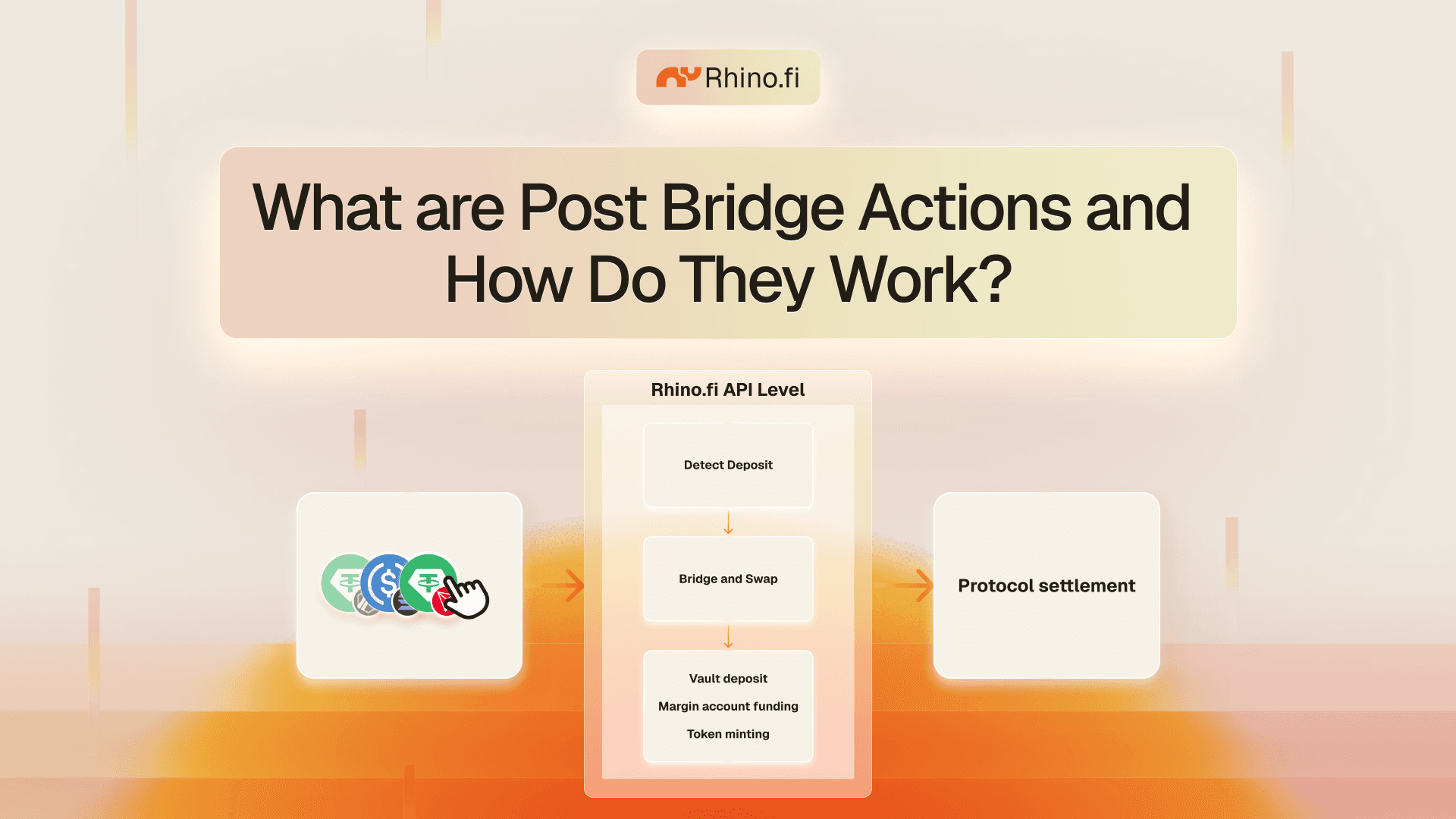
A complete technical walkthrough for teams building crosschain onboarding
The Problem
Smart Deposit Addresses solved the first part of crosschain onboarding. Users can now send funds from any chain to a single deposit address. Rhino.fi handles routing, bridging and settlement automatically.
But one friction point remained: what happens after the bridge completes. Most protocols require a final onchain action before users can operate. A vault deposit. A mint operation. A balance update. That step was still manual.
Post Bridge Actions automate it. Users deposit once. Rhino.fi bridges the funds and executes the target action in a single continuous flow. Your users land in the correct operational state without touching a wallet.
What is a Post Bridge Action?
A Post Bridge Action is an onchain instruction that executes automatically after bridging completes. It specifies exactly what should happen with deposited funds after they arrive on the destination chain.
Every Post Bridge Action contains:
Target contract: which smart contract to interact with
Action type: deposit, mint, stake, or other protocol-specific operations
User identifier: who should be credited
Parameters: vault IDs, amounts, token addresses, or custom data your protocol needs
The action configuration is embedded in the quote generated when funds arrive at a Smart Deposit Address. Rhino.fi executes it immediately after bridging, so your user never sees the intermediate step.
How the Flow Works
Step 1: User deposits
A user sends funds to their Smart Deposit Address from any supported chain. This could be USDC from Ethereum, USDT from Polygon, or any token from 15+ supported networks.
Step 2: Detection and quote generation
Rhino.fi detects the deposit and generates a quote. This quote includes the optimal bridge route and the Post Bridge Action configuration.
Step 3: Bridge execution
Rhino.fi bridges the funds to the destination chain using the most efficient route available at that moment.
Step 4: Automatic action execution
Immediately after bridging, Rhino.fi executes the Post Bridge Action onchain. This happens in the same transaction flow, eliminating any delay or manual intervention.
Step 5: Protocol settlement
Your protocol receives the funds in the exact state you need them. The user is credited instantly and can begin using your product.
The entire process typically completes in 2-15 minutes depending on source and destination chains. From the user's perspective, it's a single deposit.
Real Implementation Examples
Extended: Automated Trading Vault Deposits on Starknet
The Challenge:
Extended operates a perp DEX on Starknet with user-specific trading vaults. Before trading, users must deposit funds into their assigned vault. The legacy flow required users to bridge manually, switch to Starknet in their wallet, locate their vault contract, and complete a deposit transaction.
Significant drop-off occurred at each step, resulting in substantial cumulative friction that cost them a large portion of potential users.
The Solution:
With Post Bridge Actions, users deposit once from any chain. Rhino.fi bridges to Starknet and deposits directly into the user's trading vault using their vault identifier.
Results:
Significant reduction in time-to-first-trade
Improved deposit-to-trade conversion rates
Substantial decrease in support tickets related to bridging
Wirex: Yield-Bearing Asset Minting on Base
The Challenge:
Wirex maintains yield vaults on Base where users earn on wrapped USDC and EURC. Users needed to bridge to Base, find the vault contract, deposit stablecoins, and wait for the wrapped token mint.
The Solution:
Post Bridge Actions collapsed this into one deposit. Users send USDC or EURC from any chain. Rhino.fi bridges to Base, deposits into the Wirex vault, and the wrapped yield-bearing token is minted and sent to the user's address.
Results:
Substantial reduction in onboarding time
Near-elimination of support requests related to bridging
Higher TVL growth due to reduced friction
Why Teams Choose Post Bridge Actions
Friction Reduction
Manual steps significantly impact conversion rates. Post Bridge Actions remove the post-bridge interaction that typically creates substantial user drop-off.
Operational Simplicity
Building your own crosschain deposit system requires infrastructure for address generation, deposit monitoring, transaction management, and error handling. Post Bridge Actions eliminate that operational burden.
Developer Experience
Your integration work focuses on defining the target state, not managing bridges, monitoring deposits, or handling edge cases. Rhino.fi provides the infrastructure.
User Experience
Users don't need to understand bridges, gas tokens, or network switching. They deposit once and arrive ready to use your product.
Use Case Enablement
Some onboarding flows are practically impossible without automation. User-specific vault deposits, margin account initialization, and multi-step protocol interactions become simple with Post Bridge Actions.
Technical Specifications
Supported Source Chains:
Tron, Ethereum, Solana, Arbitrum, Base, Optimism, BSC Chain, Polygon, Kaia, Celo, Gnosis, Linea, Plasma, Zircuit, Ink, Scroll and Unichain.
Supported Destination Chains:
25+ of the most popular EVM and non-EVM chains, including all major L1s and L2s.
Chain support is continuously expanding. If you need support for a specific chain that isn't listed, contact the Rhino.fi team to discuss availability and integration timelines.
Supported Action Types:
Vault deposits (standard and user-specific)
Token minting (wrapped assets, yield tokens)
Staking and delegation operations
Liquidity provision
Margin account funding
Custom protocol interactions
Settlement Time:
2-15 minutes depending on source and destination chain. Most common routes complete in under 5 minutes.
Gas Handling:
Rhino.fi covers destination chain gas costs for the Post Bridge Action. Users only pay for their initial deposit transaction.
Error Handling:
If a Post Bridge Action fails, funds are sent to the user's destination address as a fallback. You receive webhook notifications for monitoring.
Integration Requirements
Integrating Post Bridge Actions requires:
Smart contract interface that accepts deposits or executes your target action
User identification system to map deposits to the correct user state (vault ID, account ID, etc.)
API integration with Rhino.fi to generate Smart Deposit Addresses with embedded recipes
Webhook endpoint to receive settlement confirmations
Most integrations are production-ready within 1-2 weeks depending on protocol complexity.
Getting Started
Step 1: Review the documentation
Our technical docs cover API endpoints, recipe structures, and integration patterns: docs.rhino.fi
Step 2: Design your action
Work with our integration team to define the Post Bridge Action that fits your protocol. We'll help you structure the configuration and test it in a sandbox environment.
Step 3: Implement and test
Integrate the Rhino.fi API, test deposits on testnets, and verify that Post Bridge Actions execute correctly for your use case.
Step 4: Launch
Go live with automated crosschain onboarding. We provide monitoring, support, and ongoing optimization.
When to Use Post Bridge Actions
Post Bridge Actions are built for teams whose protocols require users to complete a specific onchain interaction before they can operate.
Ideal use cases:
Perp DEXes with vault-based margin systems
Yield platforms with wrapped or receipt tokens
Neobanks requiring balance initialization
Appchains with mandatory staking or deposits
RWA platforms with minting prerequisites
Structured products with entry requirements
If your onboarding flow includes "now switch networks and complete the deposit," Post Bridge Actions replace that step with automatic execution.
Start Building
Ready to automate your onboarding flow? Our team will help you design, implement and launch Post Bridge Actions for your protocol.
Contact us:
Read the technical documentation: docs.rhino.fi
Book an integration call: rhino.fi/contact
Email: partnerships@rhino.fi
Let's remove the friction from your crosschain onboarding.
A complete technical walkthrough for teams building crosschain onboarding
The Problem
Smart Deposit Addresses solved the first part of crosschain onboarding. Users can now send funds from any chain to a single deposit address. Rhino.fi handles routing, bridging and settlement automatically.
But one friction point remained: what happens after the bridge completes. Most protocols require a final onchain action before users can operate. A vault deposit. A mint operation. A balance update. That step was still manual.
Post Bridge Actions automate it. Users deposit once. Rhino.fi bridges the funds and executes the target action in a single continuous flow. Your users land in the correct operational state without touching a wallet.
What is a Post Bridge Action?
A Post Bridge Action is an onchain instruction that executes automatically after bridging completes. It specifies exactly what should happen with deposited funds after they arrive on the destination chain.
Every Post Bridge Action contains:
Target contract: which smart contract to interact with
Action type: deposit, mint, stake, or other protocol-specific operations
User identifier: who should be credited
Parameters: vault IDs, amounts, token addresses, or custom data your protocol needs
The action configuration is embedded in the quote generated when funds arrive at a Smart Deposit Address. Rhino.fi executes it immediately after bridging, so your user never sees the intermediate step.
How the Flow Works
Step 1: User deposits
A user sends funds to their Smart Deposit Address from any supported chain. This could be USDC from Ethereum, USDT from Polygon, or any token from 15+ supported networks.
Step 2: Detection and quote generation
Rhino.fi detects the deposit and generates a quote. This quote includes the optimal bridge route and the Post Bridge Action configuration.
Step 3: Bridge execution
Rhino.fi bridges the funds to the destination chain using the most efficient route available at that moment.
Step 4: Automatic action execution
Immediately after bridging, Rhino.fi executes the Post Bridge Action onchain. This happens in the same transaction flow, eliminating any delay or manual intervention.
Step 5: Protocol settlement
Your protocol receives the funds in the exact state you need them. The user is credited instantly and can begin using your product.
The entire process typically completes in 2-15 minutes depending on source and destination chains. From the user's perspective, it's a single deposit.
Real Implementation Examples
Extended: Automated Trading Vault Deposits on Starknet
The Challenge:
Extended operates a perp DEX on Starknet with user-specific trading vaults. Before trading, users must deposit funds into their assigned vault. The legacy flow required users to bridge manually, switch to Starknet in their wallet, locate their vault contract, and complete a deposit transaction.
Significant drop-off occurred at each step, resulting in substantial cumulative friction that cost them a large portion of potential users.
The Solution:
With Post Bridge Actions, users deposit once from any chain. Rhino.fi bridges to Starknet and deposits directly into the user's trading vault using their vault identifier.
Results:
Significant reduction in time-to-first-trade
Improved deposit-to-trade conversion rates
Substantial decrease in support tickets related to bridging
Wirex: Yield-Bearing Asset Minting on Base
The Challenge:
Wirex maintains yield vaults on Base where users earn on wrapped USDC and EURC. Users needed to bridge to Base, find the vault contract, deposit stablecoins, and wait for the wrapped token mint.
The Solution:
Post Bridge Actions collapsed this into one deposit. Users send USDC or EURC from any chain. Rhino.fi bridges to Base, deposits into the Wirex vault, and the wrapped yield-bearing token is minted and sent to the user's address.
Results:
Substantial reduction in onboarding time
Near-elimination of support requests related to bridging
Higher TVL growth due to reduced friction
Why Teams Choose Post Bridge Actions
Friction Reduction
Manual steps significantly impact conversion rates. Post Bridge Actions remove the post-bridge interaction that typically creates substantial user drop-off.
Operational Simplicity
Building your own crosschain deposit system requires infrastructure for address generation, deposit monitoring, transaction management, and error handling. Post Bridge Actions eliminate that operational burden.
Developer Experience
Your integration work focuses on defining the target state, not managing bridges, monitoring deposits, or handling edge cases. Rhino.fi provides the infrastructure.
User Experience
Users don't need to understand bridges, gas tokens, or network switching. They deposit once and arrive ready to use your product.
Use Case Enablement
Some onboarding flows are practically impossible without automation. User-specific vault deposits, margin account initialization, and multi-step protocol interactions become simple with Post Bridge Actions.
Technical Specifications
Supported Source Chains:
Tron, Ethereum, Solana, Arbitrum, Base, Optimism, BSC Chain, Polygon, Kaia, Celo, Gnosis, Linea, Plasma, Zircuit, Ink, Scroll and Unichain.
Supported Destination Chains:
25+ of the most popular EVM and non-EVM chains, including all major L1s and L2s.
Chain support is continuously expanding. If you need support for a specific chain that isn't listed, contact the Rhino.fi team to discuss availability and integration timelines.
Supported Action Types:
Vault deposits (standard and user-specific)
Token minting (wrapped assets, yield tokens)
Staking and delegation operations
Liquidity provision
Margin account funding
Custom protocol interactions
Settlement Time:
2-15 minutes depending on source and destination chain. Most common routes complete in under 5 minutes.
Gas Handling:
Rhino.fi covers destination chain gas costs for the Post Bridge Action. Users only pay for their initial deposit transaction.
Error Handling:
If a Post Bridge Action fails, funds are sent to the user's destination address as a fallback. You receive webhook notifications for monitoring.
Integration Requirements
Integrating Post Bridge Actions requires:
Smart contract interface that accepts deposits or executes your target action
User identification system to map deposits to the correct user state (vault ID, account ID, etc.)
API integration with Rhino.fi to generate Smart Deposit Addresses with embedded recipes
Webhook endpoint to receive settlement confirmations
Most integrations are production-ready within 1-2 weeks depending on protocol complexity.
Getting Started
Step 1: Review the documentation
Our technical docs cover API endpoints, recipe structures, and integration patterns: docs.rhino.fi
Step 2: Design your action
Work with our integration team to define the Post Bridge Action that fits your protocol. We'll help you structure the configuration and test it in a sandbox environment.
Step 3: Implement and test
Integrate the Rhino.fi API, test deposits on testnets, and verify that Post Bridge Actions execute correctly for your use case.
Step 4: Launch
Go live with automated crosschain onboarding. We provide monitoring, support, and ongoing optimization.
When to Use Post Bridge Actions
Post Bridge Actions are built for teams whose protocols require users to complete a specific onchain interaction before they can operate.
Ideal use cases:
Perp DEXes with vault-based margin systems
Yield platforms with wrapped or receipt tokens
Neobanks requiring balance initialization
Appchains with mandatory staking or deposits
RWA platforms with minting prerequisites
Structured products with entry requirements
If your onboarding flow includes "now switch networks and complete the deposit," Post Bridge Actions replace that step with automatic execution.
Start Building
Ready to automate your onboarding flow? Our team will help you design, implement and launch Post Bridge Actions for your protocol.
Contact us:
Read the technical documentation: docs.rhino.fi
Book an integration call: rhino.fi/contact
Email: partnerships@rhino.fi
Let's remove the friction from your crosschain onboarding.
A complete technical walkthrough for teams building crosschain onboarding
The Problem
Smart Deposit Addresses solved the first part of crosschain onboarding. Users can now send funds from any chain to a single deposit address. Rhino.fi handles routing, bridging and settlement automatically.
But one friction point remained: what happens after the bridge completes. Most protocols require a final onchain action before users can operate. A vault deposit. A mint operation. A balance update. That step was still manual.
Post Bridge Actions automate it. Users deposit once. Rhino.fi bridges the funds and executes the target action in a single continuous flow. Your users land in the correct operational state without touching a wallet.
What is a Post Bridge Action?
A Post Bridge Action is an onchain instruction that executes automatically after bridging completes. It specifies exactly what should happen with deposited funds after they arrive on the destination chain.
Every Post Bridge Action contains:
Target contract: which smart contract to interact with
Action type: deposit, mint, stake, or other protocol-specific operations
User identifier: who should be credited
Parameters: vault IDs, amounts, token addresses, or custom data your protocol needs
The action configuration is embedded in the quote generated when funds arrive at a Smart Deposit Address. Rhino.fi executes it immediately after bridging, so your user never sees the intermediate step.
How the Flow Works
Step 1: User deposits
A user sends funds to their Smart Deposit Address from any supported chain. This could be USDC from Ethereum, USDT from Polygon, or any token from 15+ supported networks.
Step 2: Detection and quote generation
Rhino.fi detects the deposit and generates a quote. This quote includes the optimal bridge route and the Post Bridge Action configuration.
Step 3: Bridge execution
Rhino.fi bridges the funds to the destination chain using the most efficient route available at that moment.
Step 4: Automatic action execution
Immediately after bridging, Rhino.fi executes the Post Bridge Action onchain. This happens in the same transaction flow, eliminating any delay or manual intervention.
Step 5: Protocol settlement
Your protocol receives the funds in the exact state you need them. The user is credited instantly and can begin using your product.
The entire process typically completes in 2-15 minutes depending on source and destination chains. From the user's perspective, it's a single deposit.
Real Implementation Examples
Extended: Automated Trading Vault Deposits on Starknet
The Challenge:
Extended operates a perp DEX on Starknet with user-specific trading vaults. Before trading, users must deposit funds into their assigned vault. The legacy flow required users to bridge manually, switch to Starknet in their wallet, locate their vault contract, and complete a deposit transaction.
Significant drop-off occurred at each step, resulting in substantial cumulative friction that cost them a large portion of potential users.
The Solution:
With Post Bridge Actions, users deposit once from any chain. Rhino.fi bridges to Starknet and deposits directly into the user's trading vault using their vault identifier.
Results:
Significant reduction in time-to-first-trade
Improved deposit-to-trade conversion rates
Substantial decrease in support tickets related to bridging
Wirex: Yield-Bearing Asset Minting on Base
The Challenge:
Wirex maintains yield vaults on Base where users earn on wrapped USDC and EURC. Users needed to bridge to Base, find the vault contract, deposit stablecoins, and wait for the wrapped token mint.
The Solution:
Post Bridge Actions collapsed this into one deposit. Users send USDC or EURC from any chain. Rhino.fi bridges to Base, deposits into the Wirex vault, and the wrapped yield-bearing token is minted and sent to the user's address.
Results:
Substantial reduction in onboarding time
Near-elimination of support requests related to bridging
Higher TVL growth due to reduced friction
Why Teams Choose Post Bridge Actions
Friction Reduction
Manual steps significantly impact conversion rates. Post Bridge Actions remove the post-bridge interaction that typically creates substantial user drop-off.
Operational Simplicity
Building your own crosschain deposit system requires infrastructure for address generation, deposit monitoring, transaction management, and error handling. Post Bridge Actions eliminate that operational burden.
Developer Experience
Your integration work focuses on defining the target state, not managing bridges, monitoring deposits, or handling edge cases. Rhino.fi provides the infrastructure.
User Experience
Users don't need to understand bridges, gas tokens, or network switching. They deposit once and arrive ready to use your product.
Use Case Enablement
Some onboarding flows are practically impossible without automation. User-specific vault deposits, margin account initialization, and multi-step protocol interactions become simple with Post Bridge Actions.
Technical Specifications
Supported Source Chains:
Tron, Ethereum, Solana, Arbitrum, Base, Optimism, BSC Chain, Polygon, Kaia, Celo, Gnosis, Linea, Plasma, Zircuit, Ink, Scroll and Unichain.
Supported Destination Chains:
25+ of the most popular EVM and non-EVM chains, including all major L1s and L2s.
Chain support is continuously expanding. If you need support for a specific chain that isn't listed, contact the Rhino.fi team to discuss availability and integration timelines.
Supported Action Types:
Vault deposits (standard and user-specific)
Token minting (wrapped assets, yield tokens)
Staking and delegation operations
Liquidity provision
Margin account funding
Custom protocol interactions
Settlement Time:
2-15 minutes depending on source and destination chain. Most common routes complete in under 5 minutes.
Gas Handling:
Rhino.fi covers destination chain gas costs for the Post Bridge Action. Users only pay for their initial deposit transaction.
Error Handling:
If a Post Bridge Action fails, funds are sent to the user's destination address as a fallback. You receive webhook notifications for monitoring.
Integration Requirements
Integrating Post Bridge Actions requires:
Smart contract interface that accepts deposits or executes your target action
User identification system to map deposits to the correct user state (vault ID, account ID, etc.)
API integration with Rhino.fi to generate Smart Deposit Addresses with embedded recipes
Webhook endpoint to receive settlement confirmations
Most integrations are production-ready within 1-2 weeks depending on protocol complexity.
Getting Started
Step 1: Review the documentation
Our technical docs cover API endpoints, recipe structures, and integration patterns: docs.rhino.fi
Step 2: Design your action
Work with our integration team to define the Post Bridge Action that fits your protocol. We'll help you structure the configuration and test it in a sandbox environment.
Step 3: Implement and test
Integrate the Rhino.fi API, test deposits on testnets, and verify that Post Bridge Actions execute correctly for your use case.
Step 4: Launch
Go live with automated crosschain onboarding. We provide monitoring, support, and ongoing optimization.
When to Use Post Bridge Actions
Post Bridge Actions are built for teams whose protocols require users to complete a specific onchain interaction before they can operate.
Ideal use cases:
Perp DEXes with vault-based margin systems
Yield platforms with wrapped or receipt tokens
Neobanks requiring balance initialization
Appchains with mandatory staking or deposits
RWA platforms with minting prerequisites
Structured products with entry requirements
If your onboarding flow includes "now switch networks and complete the deposit," Post Bridge Actions replace that step with automatic execution.
Start Building
Ready to automate your onboarding flow? Our team will help you design, implement and launch Post Bridge Actions for your protocol.
Contact us:
Read the technical documentation: docs.rhino.fi
Book an integration call: rhino.fi/contact
Email: partnerships@rhino.fi
Let's remove the friction from your crosschain onboarding.