
CASE STUDY

Extended needed stablecoin deposits to arrive on Starknet and land directly in users' Privy embedded wallets and trading vaults, ready to trade in seconds. The Rhino Stablecoin Activation Stack made it possible.
$10M
max deposit or withdrawal
Supported per transaction across multiple routing rails for both deposits and withdrawals, with no blocking of smaller concurrent flows

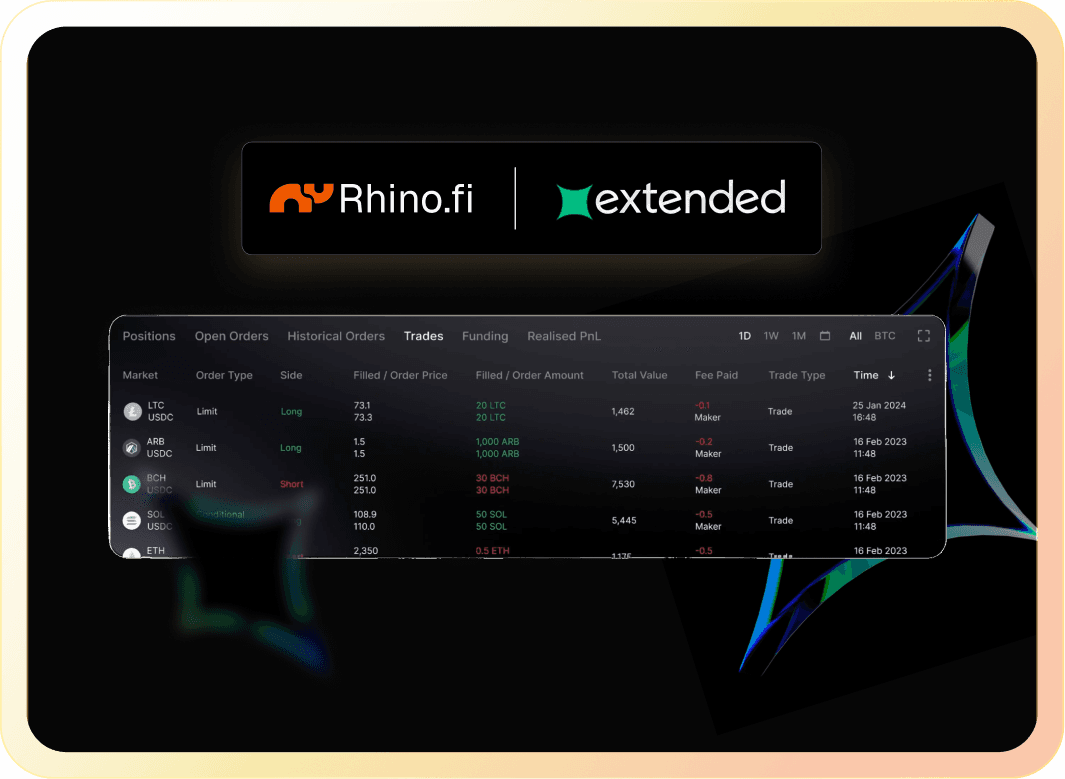
Extended is a high performance perpetual futures DEX on Starknet, built by an ex-Revolut team. Their hybrid architecture combines offchain order matching at CEX-grade latency (sub-20ms) with trustless onchain settlement via Starknet's ZK-rollup.
Extended has traded $180B+to date, with $24B in the last 30 days alone, making it the fastest growing perps DEX in the market. Their product ambition is unified margin: a single collateral pool spanning perps, spot, and lending across crypto and TradFi assets.
That means deposits don't just need to arrive. They need to arrive fast, activated, and instantly usable inside the right trading vault.
$180B+
cumulative trading volume
$1B+
peak daily volume
50+
perpetual markets
Extended's trading platform lives on Starknet. Before Rhino, their users could only deposit from Ethereum, a significant constraint on a platform competing globally for perps trading volume.
The broader problem was that funds arriving on Starknet weren't automatically deposited into trading vaults. There was a gap between "funds received" and "ready to trade" that created friction at exactly the moment users needed to act, often during volatile markets when speed matters most.
Single-chain deposit flow. With Ethereum as the only supported origin chain, users holding assets elsewhere, on Arbitrum, Base, BSC, Avalanche, or Polygon, faced friction before they could even start depositing to Extended.
The activation gap. Even when funds reached Starknet, they weren't automatically deposited into a user's trading vault. Users had to take a second on-chain step before they could trade, which slowed everything down at the worst possible moment.
Scale ceilings. As Extended's TVL grew and whale inflows increased, hard limits emerged: $1M clip constraints on certain routes, slow-path latency, and predictive balance failures under large concurrent deposit flows. The infrastructure that worked at smaller TVL wasn't built for $200M.
Operational burden. Managing routes, rebalancing liquidity, monitoring failures, and handling edge cases 24/7 during volatile markets was infrastructure Extended didn't want to own internally. They wanted to be experts in trading, not in multi-chain liquidity management.
Multi-collateral complexity on the roadmap. The path to supporting ETH, USDT, and wBTC deposits added further rebalancing and routing complexity that would have been expensive and slow to build in-house.


Extended chose Rhino because no other provider could deliver the full activation flow: funds arriving from any chain, settling on Starknet, and landing directly in the user's Privy embedded wallet and trading vault in a single transaction. Other providers could bridge. Rhino could activate.
Single-chain deposit flow. With Ethereum as the only supported origin chain, users holding assets elsewhere, on Arbitrum, Base, BSC, Avalanche, or Polygon, faced friction before they could even start depositing to Extended.
The activation gap. Even when funds reached Starknet, they weren't automatically deposited into a user's trading vault. Users had to take a second on-chain step before they could trade, which slowed everything down at the worst possible moment.
Scale ceilings. As Extended's TVL grew and whale inflows increased, hard limits emerged: $1M clip constraints on certain routes, slow-path latency, and predictive balance failures under large concurrent deposit flows. The infrastructure that worked at smaller TVL wasn't built for $200M.
Operational burden. Managing routes, rebalancing liquidity, monitoring failures, and handling edge cases 24/7 during volatile markets was infrastructure Extended didn't want to own internally. They wanted to be experts in trading, not in multi-chain liquidity management.
Multi-collateral complexity on the roadmap. The path to supporting ETH, USDT, and wBTC deposits added further rebalancing and routing complexity that would have been expensive and slow to build in-house.


SOLUTION HIGHLIGHTS
Full migration support. Rhino managed Extended's StarkEx to Starknet migration, including bridge design, monitoring of inbound transfers, automated withdrawals, and negative balance handling to allow deposits even when destination liquidity was temporarily insufficient.
Deposits land in the vault, not on the chain. Automated Onchain Actions eliminate the gap between "funds arrived" and "ready to trade."
$10M per transaction. Multi-rail routing supports whale-scale deposits and withdrawals without blocking smaller concurrent flows.
24/7 operational infrastructure. Dedicated PagerDuty alerting, a direct Slack channel into Extended's support team, and round-the-clock monitoring.
Multi-collateral expansion underway. ETH, USDT, and wBTC support via additional routing rails.
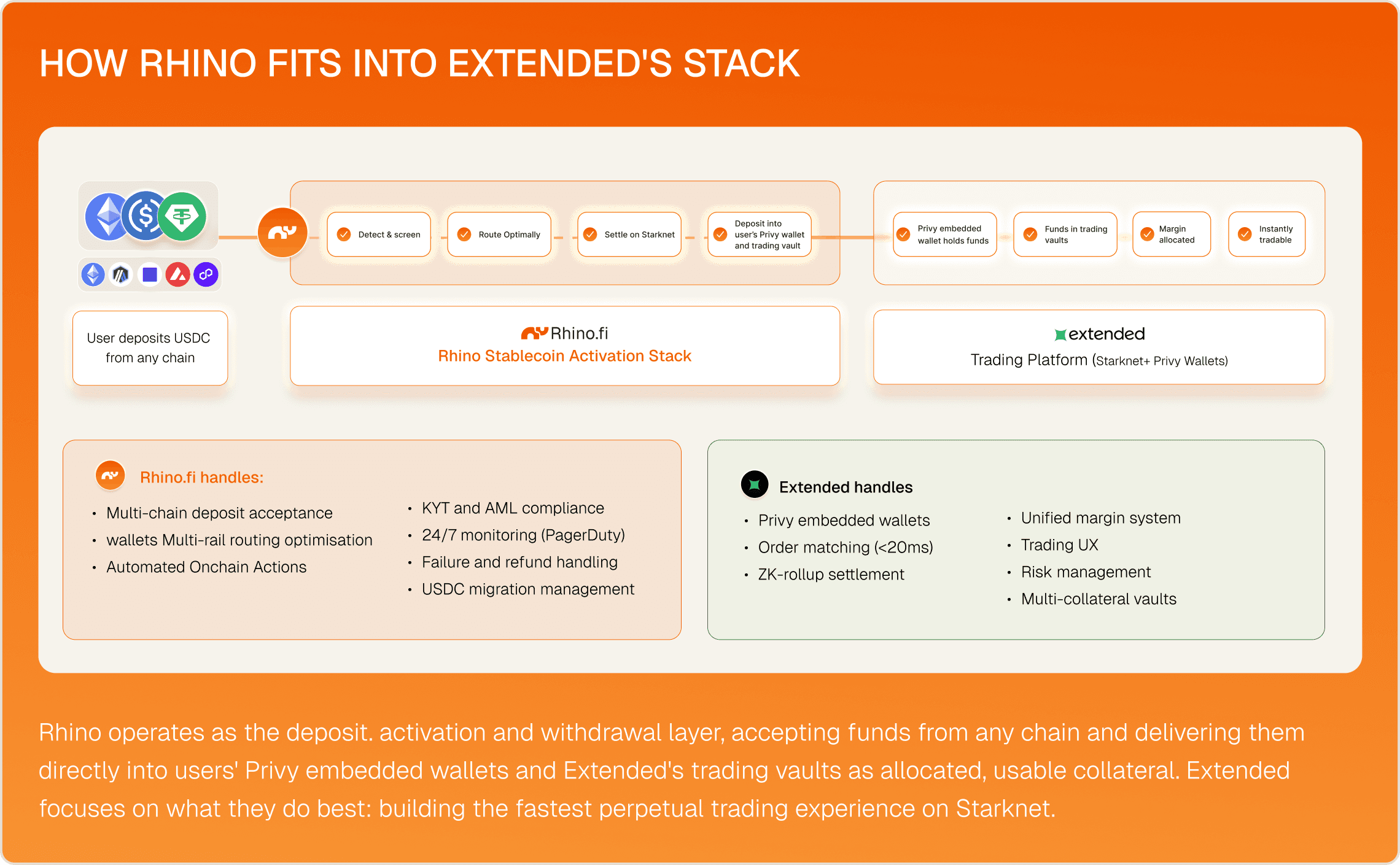
Extended's user experience is powered by two pieces of infrastructure that compose cleanly together: the Rhino Stablecoin Activation Stack handles cross-chain deposits and activation, and Privy Embedded Wallets hold and manage user funds.
The combination means a user can deposit from any supported chain, have their funds automatically routed and converted by Rhino, and land directly inside their Privy embedded wallet, credited to their Extended trading vault, all in a single flow. The user never sees a bridge interface, a chain selector, or a second transaction. They see a deposit, and seconds later, margin ready to trade.
For Extended, this means they didn't have to build either the deposit infrastructure or the embedded wallet stack. Rhino and Privy deliver a production-grade trading UX out of the box.
Extended's deposit experience has become a competitive advantage rather than an operational burden.
Sub-10 second activation, consistently.
From any of six origin chains, users have funds live in their Privy embedded wallet and trading vault in under 10 seconds on average. From ~15mins to 10 seconds means during volatile markets, when the urge to trade is highest, the deposit experience holds up rather than becoming a bottleneck.
$200M TVL reached with zero deposit infrastructure team.
Extended scaled from launch to $200M in total value locked without hiring a single engineer to manage cross-chain deposits. Over $1B in volume across 300,000+ transactions was handled entirely by Rhino's stack, letting Extended's team stay focused on trading product development.
New collateral types added without internal engineering.
Expanding from USDC only to supporting ETH, USDT, and wBTC deposits would have been months of internal work. Rhino handles the routing, rebalancing, and conversion complexity, meaning Extended can expand their collateral offering based on user demand rather than engineering capacity.
Infrastructure that scales without maintenance.
The same activation stack that handled Extended's early deposits now handles whale-scale flows up to $10M per transaction. No rebuild, no migration, no engineering work required from Extended as volumes grew.
Rhino.fi is the infrastructure behind the Rhino Stablecoin Activation Stack, giving trading platforms, neobanks, and on-chain businesses
a single toolkit to accept, convert, and settle stablecoins predictably across 30+ blockchain networks.
Over $15B in stablecoin volume processed globally. 30+ chains supported. Funds activated in under 10 seconds.