
CASE STUDY
KettlePay needed reliable, high volume stablecoin settlement between Base and Tron for its merchant payment platform, with zero slippage and predictable delivery times. Rhino replaced fragmented infrastructure and made that possible.
0
Manual top-ups
Manual reconciliation to cover spread differences removed

KettlePay is a crypto payments platform for high value, real world commerce, serving merchants in categories like real estate and luxury goods. The business handles large ticket stablecoin payments where reliability and exact settlement matter.
KettlePay processes some of the largest individual crypto payment transactions in the market, with single transfers up to $9M. Its core settlement flows are concentrated on Base and Tron, with USDC and USDT as the primary stablecoins.
200+
merchants onboarded
$250M+
lifetime volume processed
$100M+
monthly volume
KettlePay's merchants deal in large transactions. When a real estate closing or luxury purchase settles in crypto, the amount received has to match the amount sent. There is no room for slippage, delays, or failed deliveries.
KettlePay's most common payment flow though is operationally demanding: a customer pays in USD, that value is received as USDC on Base, and the merchant is paid out in USDT on Tron. In practice, Rhino supports this flow in both directions, but this Base-to-Tron route is the most common route and the most commercially important.
That creates three problems at once: cross chain movement, stablecoin conversion, and high transaction sizes. At $50,000+ per transaction, even small errors in slippage or fees are immediately visible to the merchant, and erode the trust that KettlePay's business depends on.
Tron is critical but hard to support. More than 90% of KettlePay's volume flows through Tron, and their previous setup ran into liquidity constraints on this corridor, causing delays or failed transactions when volume spiked.
Slippage damaged merchant trust. Stablecoin swaps between USDC and USDT introduced small but persistent losses, and KettlePay had to manually top up accounts to make merchants whole, a process that doesn't scale.
Settlement times were slow. Delivery could take around 15 minutes, making it difficult to offer great UX.
Per transaction fee complexity made the product harder to operate. Unpredictable fees and output amounts from third-party bridge and swap operators introduced complexity in each payment flow.


KettlePay chose Rhino.fi because we solved the two issues the previous setup could not solve consistently: guaranteed 1:1 stablecoin delivery and reliable high volume settlement on Tron.
1:1 stablecoin settlement. Rhino's Stablecoin 1:1 feature lets KettlePay treat USDC and USDT as interchangeable at a fixed rate, so the merchant receives the expected amount with no spread and no manual reconciliation. KettlePay joined the 1:1 pilot as an early partner, and the team described the capability as a 'game changer' for their business.
Deep Tron liquidity with automated rebalancing. Rhino maintains and replenishes liquidity automatically 24/7, which removes the manual intervention and liquidity shortfalls that had previously disrupted KettlePay's most important corridor.
Lower cost Tron deposits. Standard USDT transfers on Tron cost between $2.40 and $4.60 per transaction at current network rates. Rhino’s API delivers an optimised cost of $0.50 per deposit, using Tron energy rental and enterprise-grade webhook and RPC redundancy to cut costs without compromising performance or SLAs. At KettlePay's volumes, with 90%+ of flow on Tron, that difference compounds into meaningful monthly savings that KettlePay can either retain or pass through to merchants.
Enterprise style fee handling.
Rhino invoices KettlePay monthly rather than introducing per transaction fee friction, which helps KettlePay keep the end user experience clean and commercially flexible. Rhino also provides additional flexibility, covering all gas fees, and providing KettlePay the functionality to charge fees directly to their clients.
Built for high value transactions. Rhino's infrastructure is designed for the six figure and larger payment flows KettlePay's merchants actually need. KYT and AML monitoring are built in by default.


SOLUTION HIGHLIGHTS
Best in class Tron support. Rhino's value is strongest on the corridor KettlePay relies on most: Tron. Tron USDT is one of the most widely used payments corridors for stablecoins but is challenging and expensive to support, requiring custom infrastructure managed by Rhino.
Up to 70% lower Tron deposit costs. Optimised to $0.50 per deposit versus $2.40-$4.60 network average, using Tron energy rental and RPC redundancy.
Zero slippage on stablecoin settlement. The 1:1 model removes the spread leakage that previously created operational overhead.
15 minutes to under 60 seconds. Reliability and speed directly building trust for KettlePay's end customers.
Automated liquidity management. Rhino keeps the corridor funded 24/7 without manual intervention from KettlePay.
Commercial flexibility without visible fee noise. KettlePay retains control over how fees are handled in its product experience.
Since going live in late March 2026, KettlePay has transformed its merchant settlement experience.
$57K average transaction, settled in seconds.
KettlePay has processed over $115M since launch with Rhino in April. Every transaction settled predictably, with merchants receiving exactly what their customers sent.
15x faster settlement on the primary chain.
Base USDC to Tron USDT, where the majority of KettlePay's merchant volume flows, now settles in under a minute. Previously, settlement on this corridor was slower and less predictable, with liquidity-dependent delays that made it difficult to give merchants reliable timing.
Accelerated weekly volume growth, zero infrastructure changes.
KettlePay's business is scaling fast, and their settlement infrastructure scales with it, no additional engineering work required.
Zero slippage, zero manual reconciliation.
The operations overhead from their previous setup, manually topping up accounts to cover spread differences, is gone. 1:1 stablecoin settlement means every merchant receives the exact amount their customer sent.
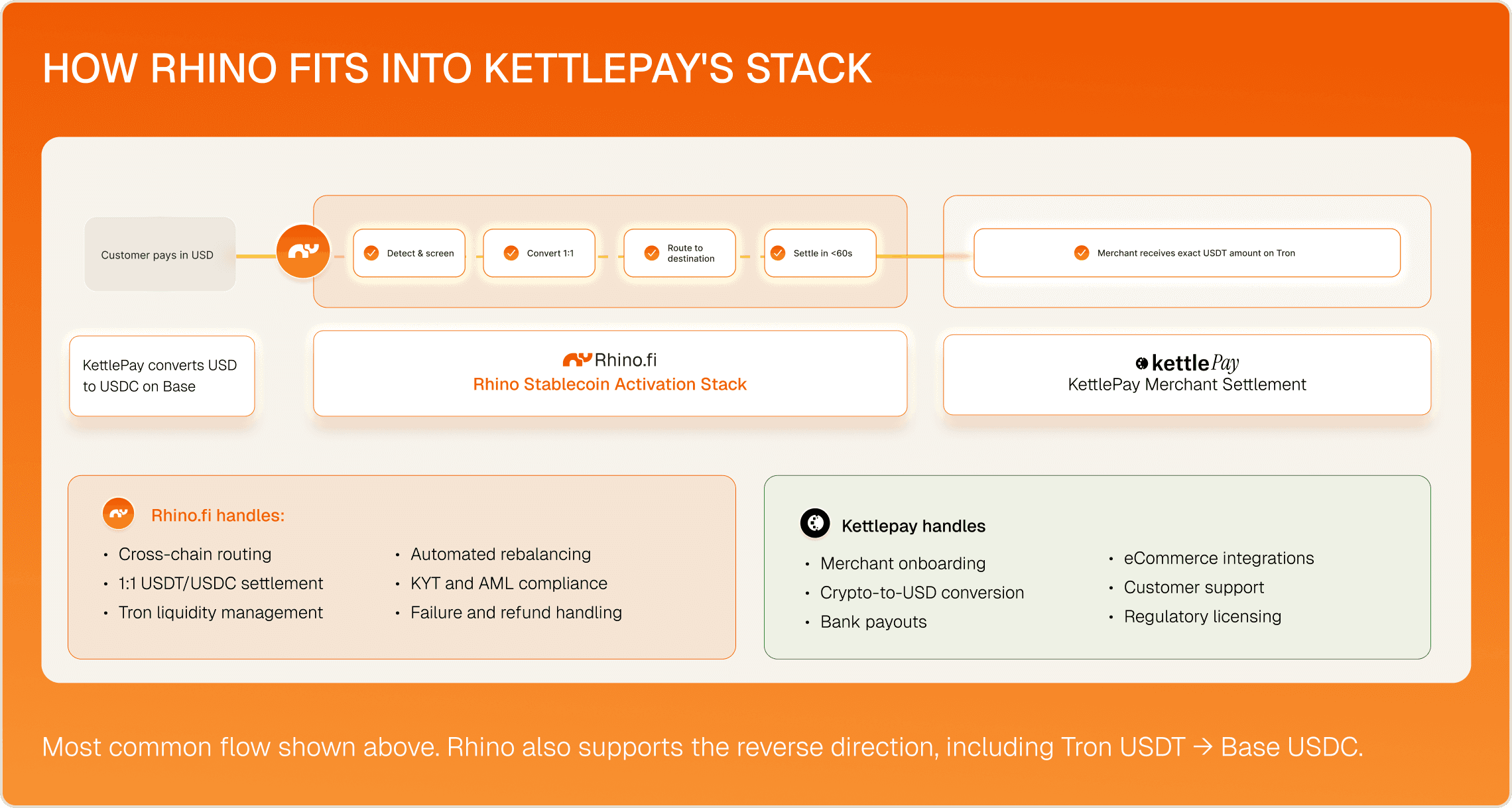
Rhino.fi is the infrastructure behind the Rhino Stablecoin Activation Stack, giving trading platforms, neobanks, and on-chain businesses
a single toolkit to accept, convert, and settle stablecoins predictably across 30+ blockchain networks.
Over $15B in stablecoin volume processed globally. 30+ chains supported. Funds activated in under 10 seconds.