


Rhino.fi now supports Open USD (OUSD), the stablecoin governed by Open Standard, on Tempo. Deposit USDC or USDT from supported networks, settle as OUSD on Tempo, and pay out as USDT on Ethereum or Tron.

Rhino.fi vs LI.FI, the bridge aggregator, for stablecoin payouts: who backs the quoted amount, LI.FI’s solvers and bridges or Rhino.fi’s own reserves.

Stablecoin settlement is when a payment is final and usable. Rhino.fi, a stablecoin payments API, explains finality, sweeping, token versions and risk.

This is the most ambitious use of AI we have attempted at rhino.fi, on the biggest single piece of engineering work we have ever shipped. The numbers tell the story.

Rhino.fi, Relay, Bridge, LI.FI, Fireblocks, Privy and BVNK compared: five types of stablecoin infrastructure companies, and when each is the right choice.

Today we’re launching the new Rhino.fi Console, a fully redesigned home for every team that moves stablecoins with Rhino.fi. More teams are using the Console every month, so we gave it the upgrade it deserved, making stablecoin deposits and cross-chain movement easier to run, monitor and scale.

Deterministic settlement means knowing a payment’s exact amount and timing before it’s sent. Learn why chains alone can’t guarantee it, with real data.
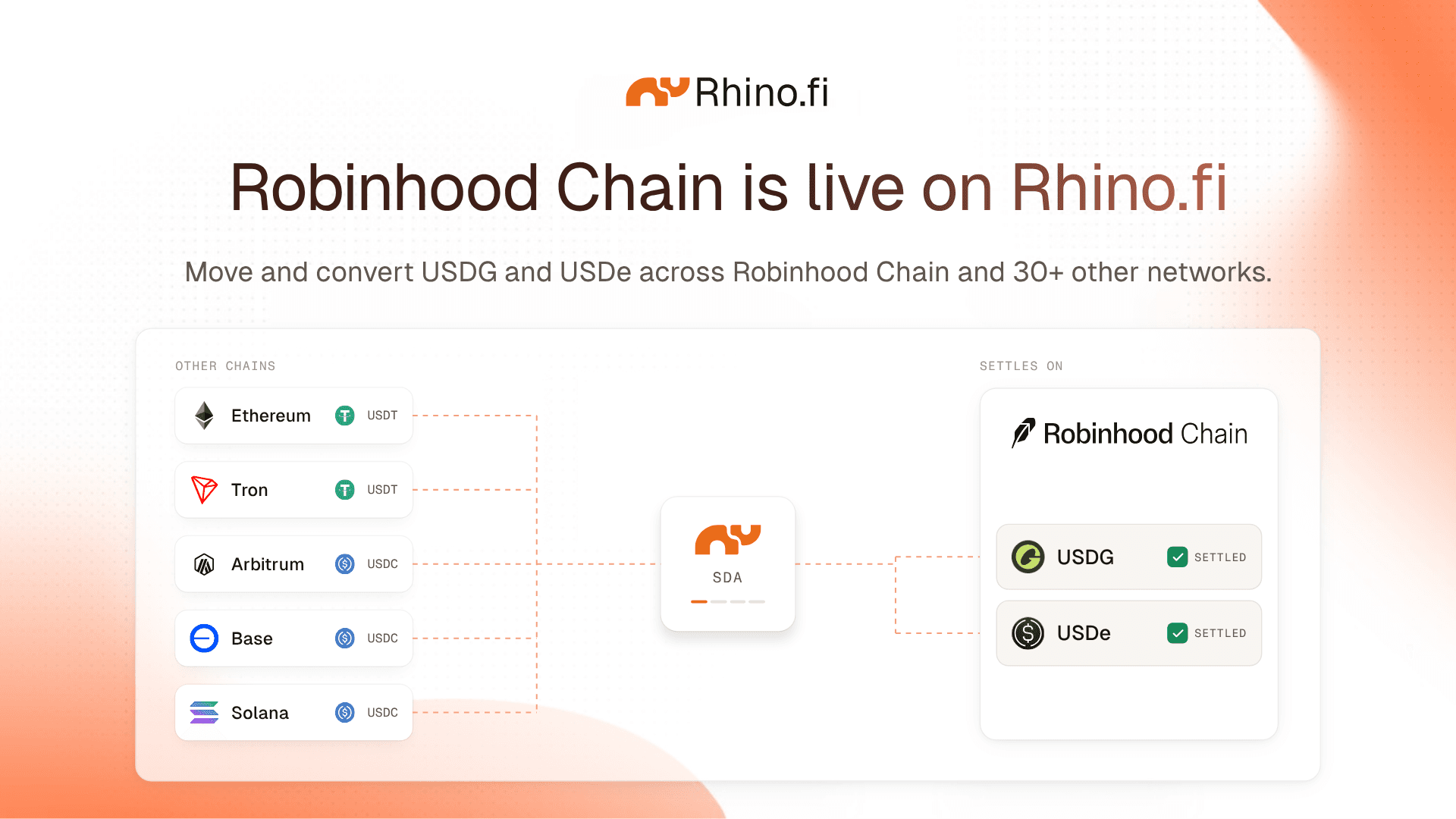
Rhino.fi now supports Robinhood Chain, the Ethereum Layer 2 that Robinhood launched on 1 July 2026. Businesses can accept USDG and USDe from Robinhood Chain through Smart Deposit Addresses (SDAs).

From day one of Arc mainnet, Rhino.fi is connecting it to the assets and networks businesses and their customers already use.